Why crowns and veneers look fake (it is not your dentist)
A crown that reads slightly flat in daylight is almost never a technique problem. It is a distance problem. The person who built your tooth has probably never seen your face, and worked from a single number on a form.

You can usually tell. Not in the mirror at the clinic, where the light is even and everything looks fine. Later. In a photograph, or standing near a window, or in the front camera of your own phone.
One tooth reads slightly flat. It is the right colour and the wrong material. Everything else in your mouth catches the light and that one does not.
Almost everybody who notices this blames the dentist. It seems obvious. Somebody chose the shade, somebody fitted it, and it came back not quite right.
That assumption is wrong, and it lets the real cause off the hook completely.
It is not your dentist. It is the handoff.
Here is the part nobody explains.
The person who actually built your crown has almost certainly never seen your face.
They are a dental ceramicist, they work in a separate laboratory somewhere else, and everything they know about your tooth arrived on a form. A shade code. A2. B1. A number chosen from a swatch book, written down, posted off, and interpreted by a stranger under different lighting in a different building in a different city.
Your dentist did their job. The lab did its job. The information between them was thin, and thin information is what produces a tooth that is nearly right.
What a shade code actually leaves out
Think about what a natural tooth is doing.
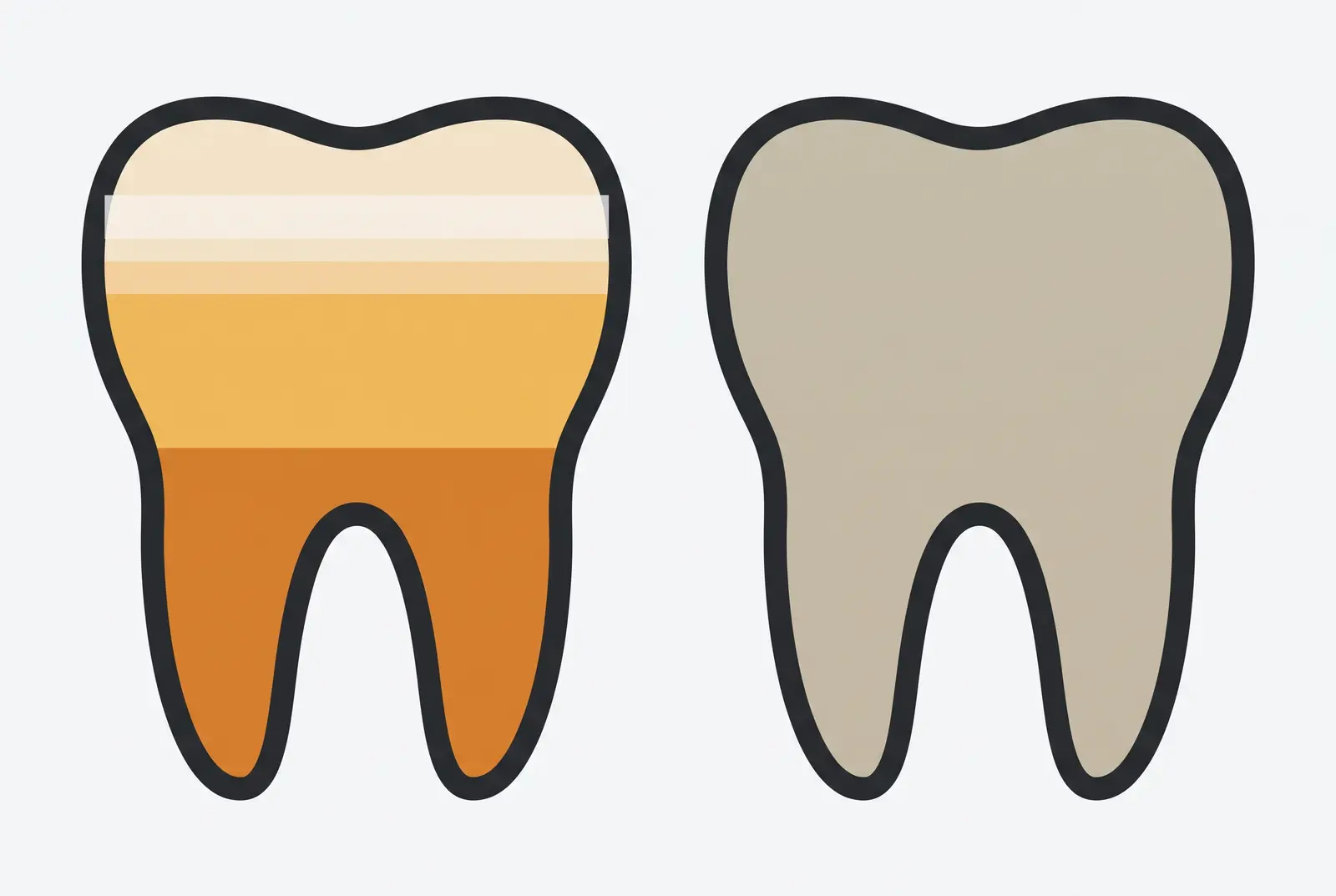
It is not one colour. It is darker at the gum and lighter at the edge. It is more opaque in the middle and slightly see-through at the tip, where light passes right through the enamel. It has faint lines, tiny surface texture and a particular way of catching the light that changes as your head turns.
A shade code carries none of that. It carries one flat value.
So a ceramicist working from a code has to guess the rest. They are very good at guessing. But guessing the translucency of the edge of your front tooth, from a number, in another state, is not the same as looking at the tooth next to it.
That single missing thing, translucency at the edge, is the most common reason a restoration reads as fake. Get the colour perfect and the light wrong, and the eye still knows.
The four places it goes wrong
The shade is picked from a book. Swatch books are held next to your tooth under clinic lighting, which is not the lighting you live in. Daylight tells a different story.
The lab works from a photograph. Better than a code. Still a flat image with its own white balance, taken in a room the ceramicist has never stood in.
The case is posted. Two weeks each way. If a fitting is a little off, the correction is another round trip, another appointment, and another fortnight of a temporary crown.
The case goes offshore. Cheaper, and the information gets thinner again. The people building your tooth are now several time zones and one shipping company away from anybody who has met you.
None of these is anybody behaving badly. They are all just distance.
What changes when the lab is in the building
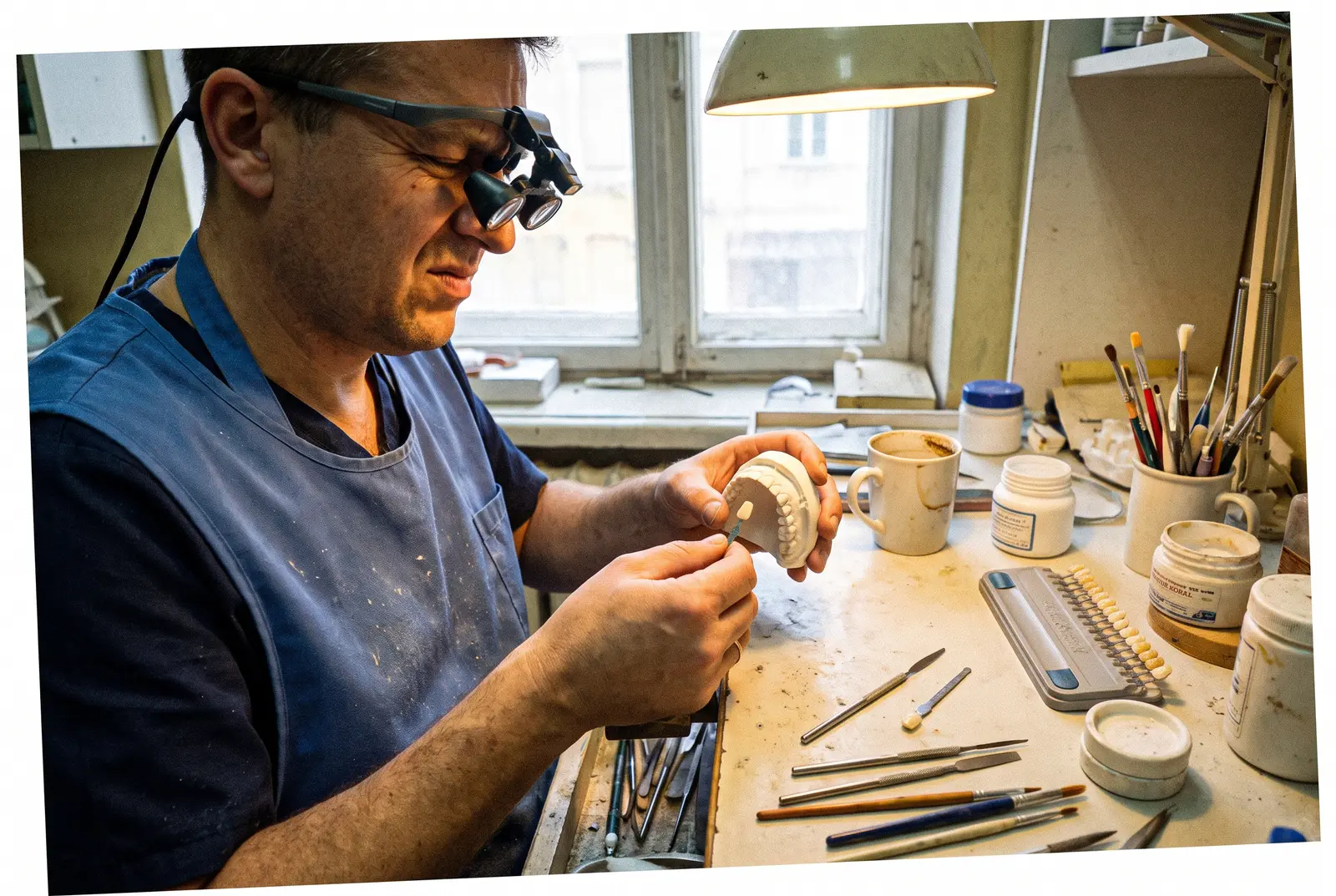
Luminous Dental Ceramics is our own lab, at our Southport clinic. The ceramicists there are on the same team as the dentists who fit what they build.
That turns the whole problem around, because the ceramicist can walk to the chair.
They see your teeth in the room, in the light of the room, next to your face. Not a code and not a photo. They can read how the colour shifts from gum to edge on the teeth either side. They can match the translucency at the tip to its neighbours, because they are looking at the neighbours.
Our ceramics team has more than 55 years of combined craft between them, and every case is built here in Australia. Nothing is sent offshore.
And when a fitting needs a small adjustment, the lab is a short walk away, so it happens the same day. No posting. No fortnight. No second temporary.
The honest part
This does not make every case perfect. Teeth are difficult, and anybody who tells you their results are flawless is telling you something else.
What it removes is a specific, avoidable failure. The one where everybody did their job properly and the answer still came back nearly right, because the only thing connecting two skilled people was a number on a form.
Brandon, who had full-arch work built at our Southport clinic over eight months, described the process rather than the result in his review: "they are so careful with their work", and "They take pride of their Workmanship."
That is the thing an in-house lab actually buys. Not a promise about how your teeth will look, which nobody can honestly make in advance. Care taken at the point where care usually gets lost.
The question worth asking any practice
If you are looking at crowns, veneers or implant teeth, the question that matters most is not the price and it is not the timeline. Both of those you will be told.
Ask this instead: who actually makes my teeth, and will they ever see my face?
Any practice can answer it in one sentence. Listen to which sentence you get. "We use a great lab" is a different answer from "the person building it works here."
Two ways to go from here
You can have the work done and hope. Most restorations are fine. Some come back nearly right, and by then it is fitted, paid for, and awkward to raise.
Or you can find out what is planned before anything is made. Your cosmetic consult includes a digital preview of the result, so you see the shape and the proportions before a single tooth is prepared.
And if you have had work done elsewhere that never looked right, bring the records in. We will tell you honestly what happened and what we would do differently. Sometimes the answer is that it can be improved. Sometimes it is that it is fine and the lighting in your bathroom is unkind. Both of those are worth knowing.
Read more: Porcelain veneers and what they can fix
Cosmetic dentistry FAQ
What does a dental ceramicist actually do?
They hand-build and shade the porcelain parts: crowns, veneers, bridges and the teeth fixed onto implants. The work is done in layers, building up porcelain to match the translucency and surface texture of a real tooth. The result depends on skill and on information, and a ceramicist who has seen your face and the teeth either side has far more to work with than one matching a code on a form.
Why does my crown look fine in the clinic and wrong in photos?
Clinic lighting is even and bright, which flatters everything and hides differences in translucency. Daylight and camera flash both come from one direction, which is when a restoration that is the right colour but the wrong material starts to read differently from the teeth beside it.
Does having the lab on site make my treatment cost more?
Not in a way that raises your price. Because the lab is ours, there is no external lab margin added to your case. What you gain is a closer match, same-day adjustments where they are needed, and none of the delay that comes from posting a case to another building.
Can an existing crown or veneer that looks wrong be fixed?
Sometimes, and sometimes it is better than you think. Bring in your records and we will tell you honestly which it is. A restoration that is genuinely mismatched can usually be remade. One that is fine but sitting under unkind bathroom lighting is worth knowing about before you spend money on it again.
Do you send any work overseas?
No. Every case is built at Luminous Dental Ceramics, our own lab at the Southport clinic, by a team with more than 55 years of combined craft between them.


