The room in Southport where teeth are made by hand
There is a gap in the middle of getting a crown that nobody explains. Your tooth is shaped, a scan is taken, and a while later a finished tooth is waiting. This is what happens in between, step by step, in our own lab.


There is a gap in the middle of getting a crown that nobody explains.
You come in. The tooth is shaped, a scan is taken, a temporary goes on. Then you go home, and you come back a while later, and there is a finished tooth waiting for you.
Something happened in between. Almost no patient ever finds out what.
This article is that gap. It is not about whether you need a crown, and there is nothing to decide at the end of it. It is just the account of how one small object gets made, in a room at our Southport clinic, by people whose entire job is making teeth.
The room
The lab is called Luminous Dental Ceramics. It is at our Southport clinic, and it looks less like a laboratory than people expect. It is closer to a jeweller's bench. Good light, hand tools laid out in a row, a lamp on an arm, and somebody sitting very still doing something very small.
The team there has more than 55 years of combined craft between them. That is the whole trade: not fast, not automated, just a long time spent getting better at one difficult thing.
Step one: your tooth becomes data
The old way of recording a tooth was a tray of putty pressed into your mouth while you tried not to gag. It worked and everybody hated it.
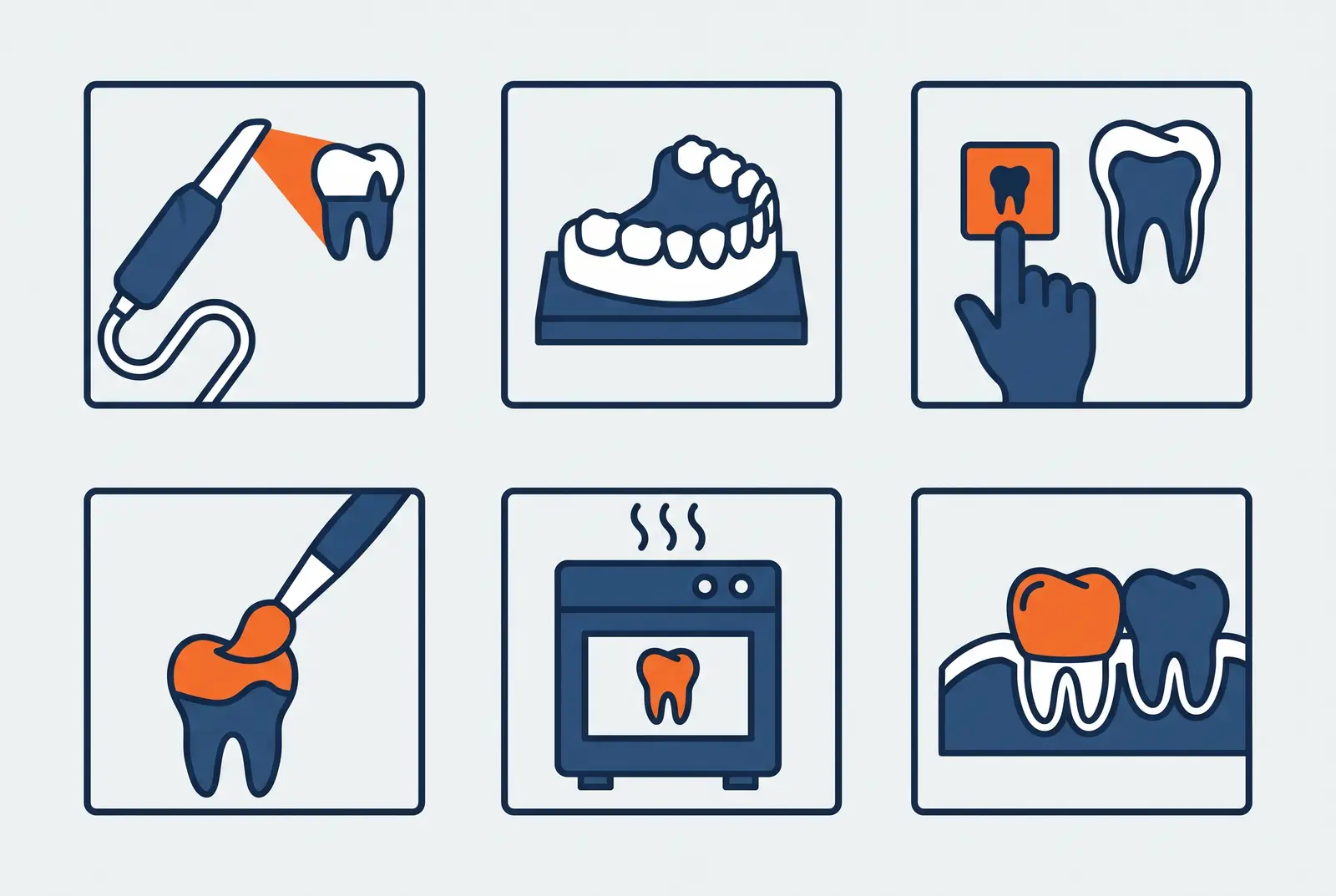
Now it is a scan. A small wand passes over the tooth, and the shape of it, the teeth either side, and the way your bite meets are captured as a digital model. For full-arch cases at Southport this is a RAY 3D scan, which reads the bone as well as the surface.
Two useful things fall out of this. The record is exact, and it can be sent down a corridor instead of down a courier's van.
Step two: your tooth gets a stand-in
The digital model becomes a physical one. A pale cast of your arch, which the ceramicist can hold, turn over, and hold your new tooth against.
This is why a model matters. A crown is not judged on its own. It is judged against the two teeth beside it, from the angle other people actually see you from. A screen cannot really tell you that. A model in your hand can.
Step three: somebody walks down the corridor
This is the step that only exists because of geography, and it is the reason the lab is where it is.
The ceramicist comes to the chair.
They look at your actual teeth, in the actual light of the room, next to your actual face. They are not reading a shade code off a form. They are looking at how your enamel changes from the gum down to the edge, where it goes slightly see-through, whether there are faint lines in it, whether one tooth is a shade warmer than its neighbour.
In most of the industry this step is a phone photo and a number. Here it is a two-minute walk.
Step four: it is built up, not carved out
A porcelain tooth is not cut from a block. It is built.
The ceramicist mixes fine ceramic powders into a paste and lays them onto the framework with a small sable brush, in layers. A more opaque layer for the body of the tooth. A more translucent one for the edge, so that light behaves the way it does in a real tooth. Warmer near the gum. Cooler at the tip.
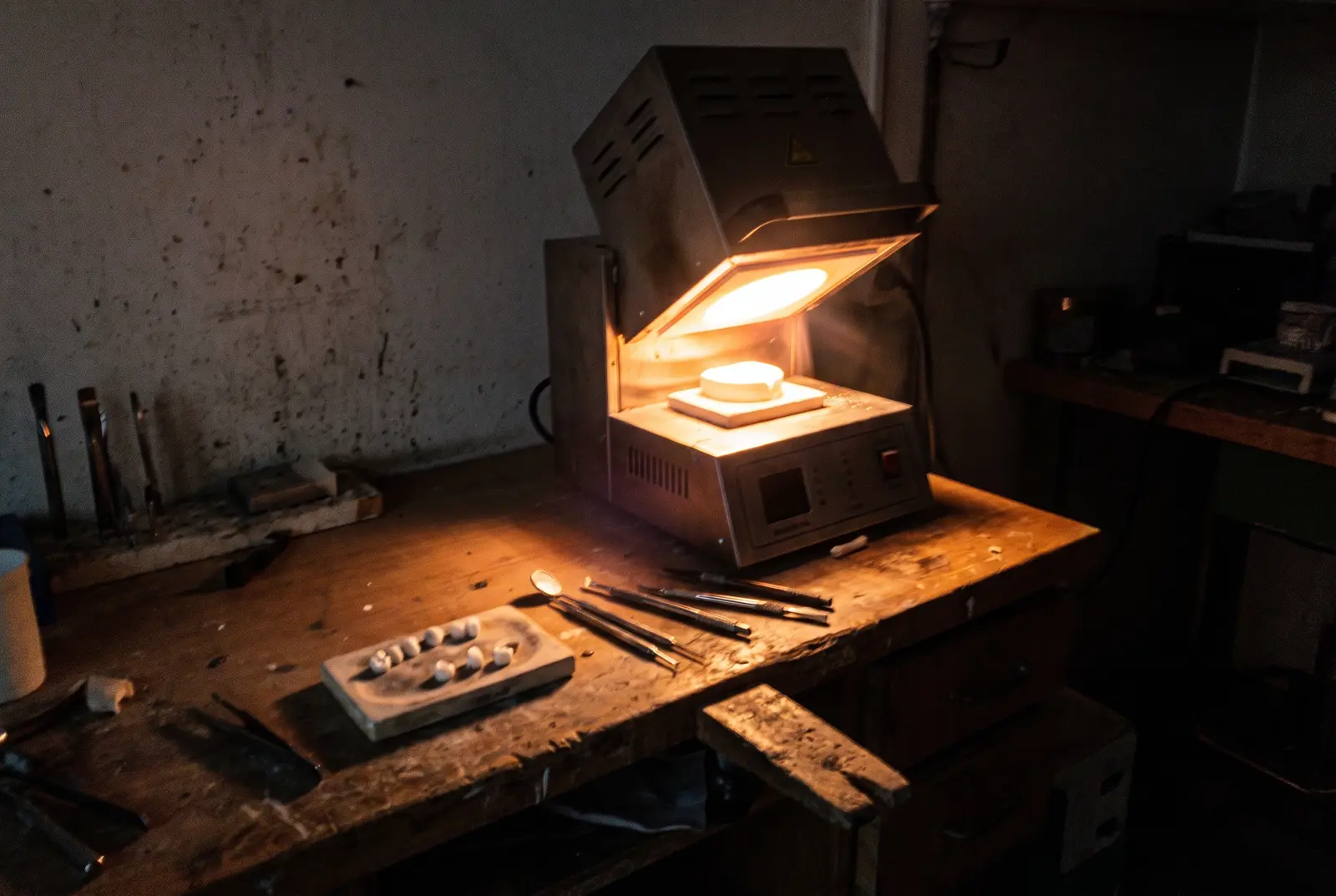
Each stage has to be fired before the next one goes on, and porcelain shrinks in the firing. So the ceramicist is building slightly oversized, for a shape they will only see after the heat has done its part. That is the skill, and it is why this is a trade you get better at for decades rather than months.
Step five: the part you are not supposed to notice
At this point the tooth is the right shape and the right colour, and it will still look wrong, because it is too perfect.
Real teeth are not smooth. They have tiny ridges, faint texture, a surface that scatters light instead of bouncing it back in one clean highlight. A ceramicist puts that back in by hand, deliberately, at the very end. Then the whole thing is glazed.
It is a strange job. The last hour of work is spent making something look less manufactured than it is.
Depending on the case the material might be porcelain, zirconia or e.max, and where it suits, the whole thing is metal-free. That is not just a look. A metal substructure is what puts the grey line at the gum on older crowns.
Step six: it comes back down the corridor
The tooth is fitted, bonded, and your bite is checked.
Here is where the geography pays off a second time. If the bite is a fraction high, or a contact point is a little tight, the person who made it is a short walk away. The adjustment happens the same day.
At a practice using an external lab, that same fraction of a millimetre means the case goes back in the post, you keep the temporary, and you come back in a fortnight.
The unglamorous truth
Most of this is not dramatic.
There is a lot of waiting for ovens. There is a lot of somebody squinting at something two centimetres across under a lamp. Nobody in the room is having a breakthrough. They are doing the same careful thing they did yesterday, slightly better.
That is what you are actually buying when a practice makes its own teeth. Not a machine and not a claim. Attention, applied to a small object, by somebody who will still be down the corridor if it needs changing.
Why any of this is worth knowing
You do not need to understand porcelain layering to get a crown. That is our job.
But knowing the shape of the process changes the questions you can ask, at any practice, anywhere. Who makes it. Whether they will see you. What happens if it needs adjusting. Whether it goes on a plane.
Those are good questions, and you can only ask them once you know there is a gap in the middle worth asking about.
If you want to see the work rather than read about it, the smile gallery is real cases built in this room.
Behind the scenes FAQ
How long does a crown take to make?
It depends on the case and the material. What takes the time is not one long job but a sequence of short ones with firing in between, plus the checks in between those. Your dentist will give you the timeline for your own case, and you wear a temporary while the work is done.
Why does porcelain have to be fired more than once?
Because it is built in layers with different properties, and each layer has to be set before the next is applied. A more opaque layer forms the body of the tooth and a more translucent one forms the edge, which is what makes light behave the way it does in a real tooth.
What is my crown actually made of?
Depending on the case it might be porcelain, zirconia or e.max. Where it suits, the whole thing is metal-free, which is what avoids the grey line at the gum that older crowns can show.
Can I see the lab?
The lab is at our Southport clinic and it is part of the practice, not a separate facility. If you are having cosmetic or full-arch work planned there, ask your dentist about meeting the ceramicist working on your case.


